MTL4016 | MTL Switch/Proximity Detector Interface, 2-Channel
PLC
- Brand: MTL
- Part Number:
MTL4016 - Availability: Ask for quote
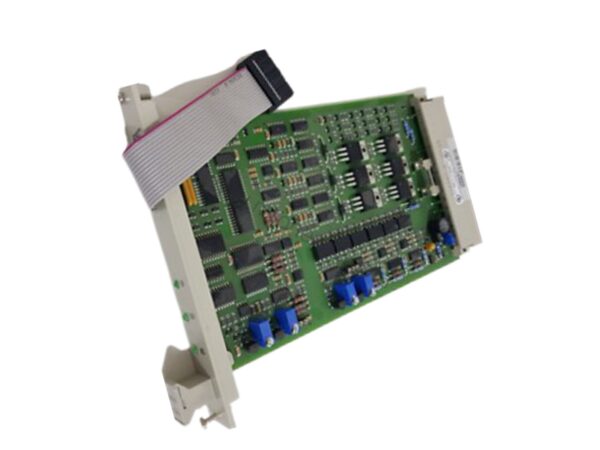
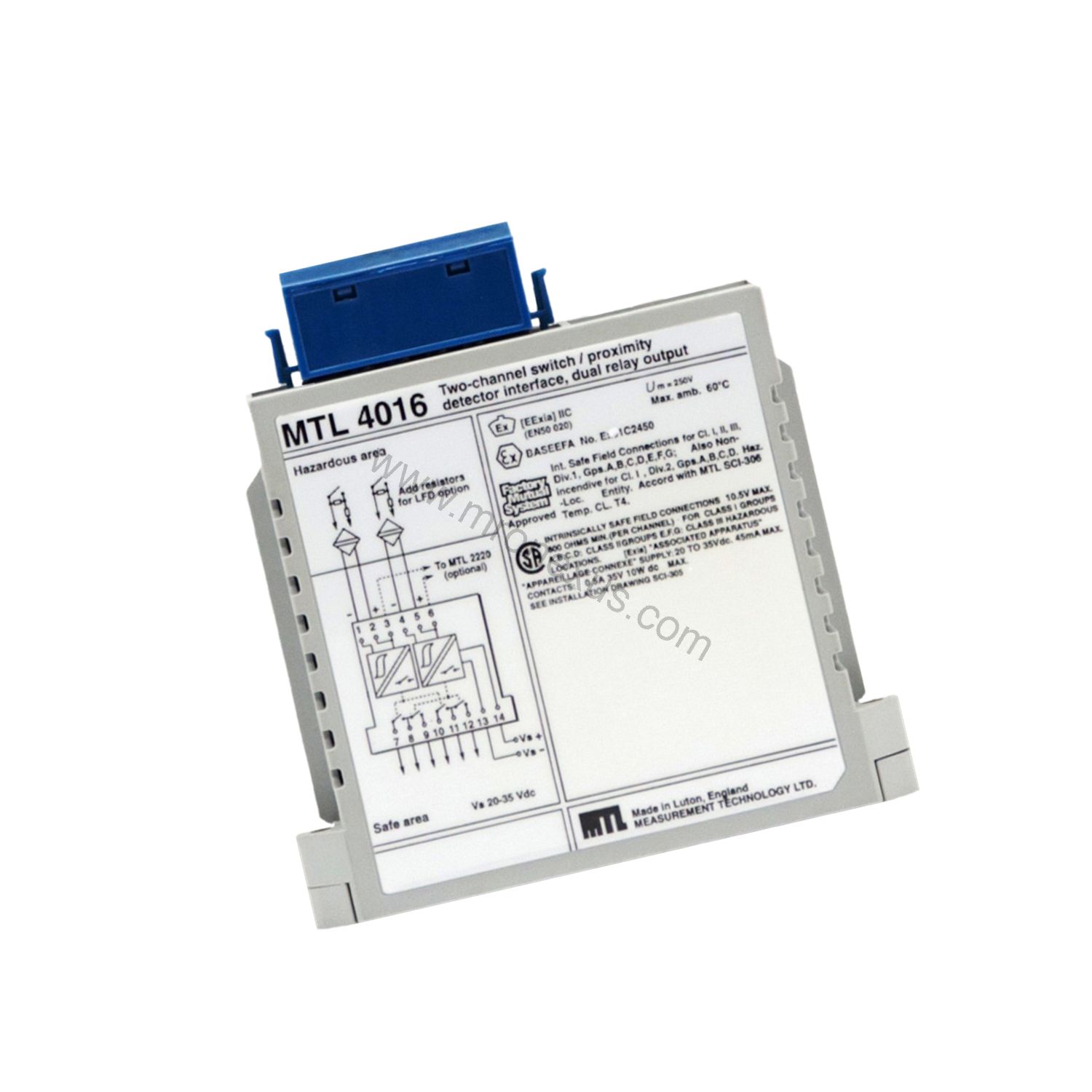
The MTL4016 is a 2-channel switch/proximity detector interface that provides reliable signal transfer from hazardous to safe areas. It features line fault detection, phase reversal, and relay outputs.
Product Details
Reliable Hazardous-Area Signal Transfer with the MTL4016
In industrial processes where hazardous areas are present, the safe and reliable transfer of sensor signals to control systems is critical. The MTL4016 switch/proximity detector interface from MTL is engineered to meet this challenge, allowing two switches or proximity detectors located in a hazardous area to each control two safe-area loads. This dual-channel interface is ideal for applications where sensor status must be fed to two separate systems, such as control and shutdown, ensuring redundancy and enhanced safety.
MTL, a trusted name in intrinsic safety and industrial automation, has designed the MTL4016 with a focus on reliability and flexibility. Whether you are upgrading an existing system or building a new one, this module provides a robust solution for signal isolation and conversion. At Mronexus, we supply genuine MTL parts at competitive prices, ensuring you receive reliable components backed by fast delivery from stock. Our one-stop sourcing approach means you can fulfill all your automation needs—from PLCs and HMIs to servo systems and sensors—in a single place.
Key Features and Technical Specifications
- Two independent channels: Each channel supports a switch or proximity detector input and provides two relay outputs.
- Hazardous area location: Suitable for Zone 0, IIC, T6 and Div.1, Group A hazardous locations.
- Sensor voltage: 7.0V to 9.0V dc from 1kΩ, compatible with NAMUR and DIN 19234 standards.
- Input/output characteristics: Outputs close if >2.1mA (<2kΩ) and open if <1.2mA (>10kΩ) in the sensor circuit, with 200µA hysteresis.
- Phase reversal: Independent switches on top of the module allow alarm signalling for either sensor state.
- Line fault detection (LFD): Detects broken or shorted lines, opening outputs if input current <100µA or >6.5mA.
- Earth fault protection: Optional connection to MTL4220 earth leakage detector for ‘no-fail’ protection.
- Relay outputs: Double-pole on/off, contact rating 10W, 0.5A, 35V dc, with 2ms maximum response time.
- LED indicators: Amber LED per channel (output closed) and green LED for power indication.
- Power requirement: 50mA at 24V dc, 60mA at 20V dc, 45mA at 35V dc; power dissipation 1.2W at 24V, 1.6W at 35V.
- Isolation: 250V ac between safe and hazardous area circuits.
- Safety description: 10.5V, 800Ω, 14mA per channel; FM entity parameters Voc=10.5V, Isc=14mA, Ca=2.4µF, La=165mH.
A standout feature of the MTL4016 is its integrated line fault detection, which continuously monitors the sensor wiring for open or short circuits. This proactive diagnostics capability helps prevent undetected failures that could compromise safety or cause unplanned downtime. When a fault is detected, the outputs open, and the fault can be signalled to the control system, allowing maintenance personnel to take corrective action quickly.
Applications and Use Cases
The MTL4016 is particularly suited for applications where redundant signal paths are required. For example, in an emergency shutdown (ESD) system, a single proximity sensor might need to trigger both a control action and a shutdown action. The MTL4016 allows the sensor signal to be routed to two separate safe-area loads, ensuring that both systems receive the signal independently. This is crucial in high-reliability industries such as oil and gas, chemical processing, and power generation.
Another common use case is in alarm systems where the status of a switch needs to be monitored by both a local control system and a remote monitoring station. The phase reversal feature allows the alarm to be configured for either the open or closed state of the sensor, providing flexibility in system design. Additionally, the earth fault detection capability, when used with the MTL4220, ensures that faults on either line are detected without interrupting the signal, maintaining system integrity.
In industries where hazardous areas are present, the MTL4016 provides a reliable interface between field devices and control systems, helping to maintain safety and operational efficiency. Its robust design and comprehensive diagnostics make it a valuable component in any safety instrumented system.
Compatibility and Integration
The MTL4016 is designed to integrate seamlessly with a wide range of industrial control systems. Its relay outputs can be connected to PLCs, DCS, or other control equipment, providing dry contacts for signal transfer. The module’s input is compatible with NAMUR proximity detectors and switches, making it a versatile choice for various sensor types.
For systems requiring communication protocols such as PROFINET or EtherNet/IP, the MTL4016 does not directly support these fieldbuses. However, it can be integrated into such networks via external gateways or connection modules. When planning integration, it is advisable to confirm cable and gateway compatibility with the supplier to ensure proper operation. Mronexus can assist in selecting the right accessories for your specific network architecture.
The MTL4016 also features optional earth fault detection through the MTL4220 earth leakage detector. This allows for continuous monitoring of earth faults without affecting the signal path, enhancing system reliability. The module’s isolation rating of 250V ac between safe and hazardous area circuits ensures safe operation and protects equipment from voltage transients.
Installation and Maintenance
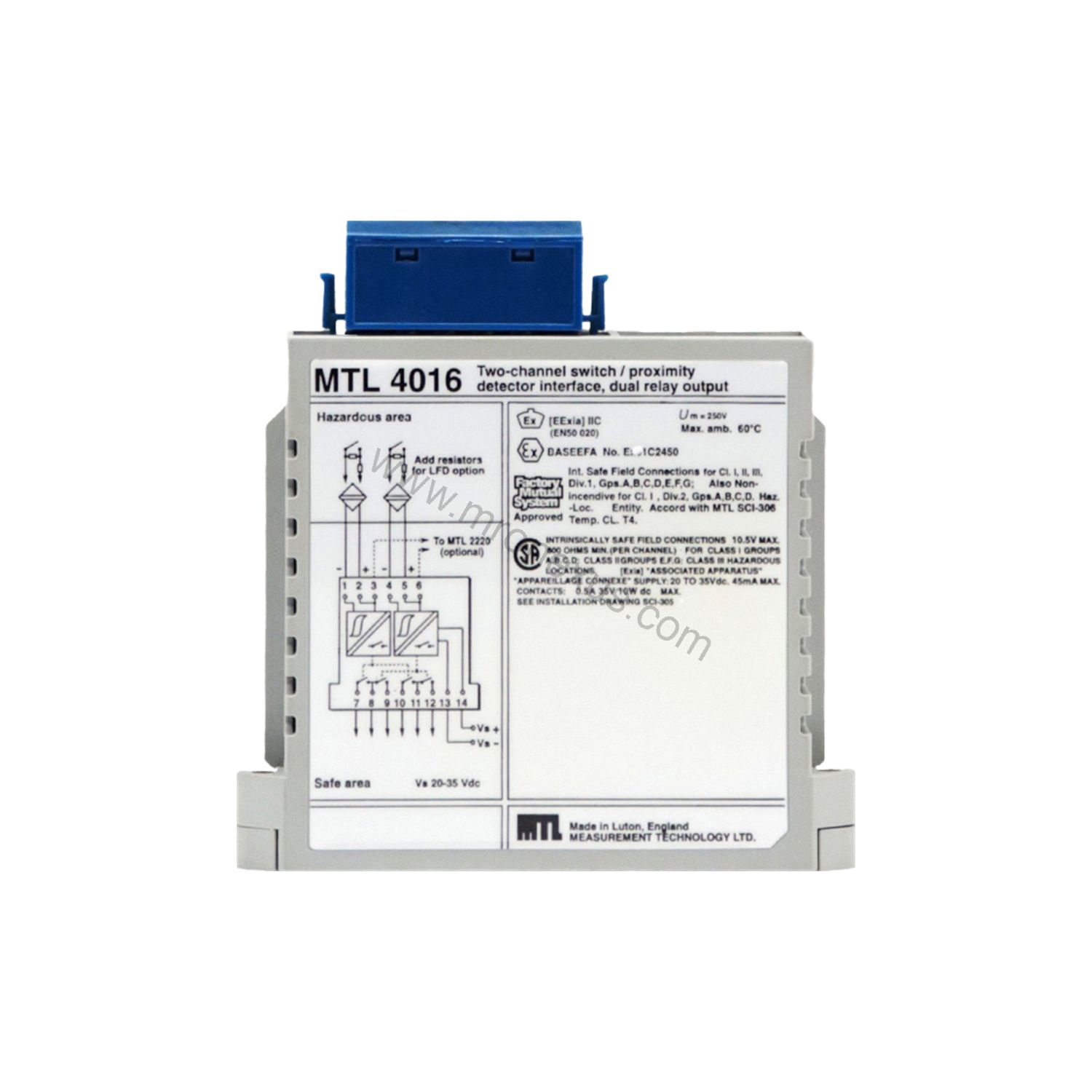
Proper installation of the MTL4016 is essential for reliable operation. The module should be mounted in a safe area, with field wiring from the hazardous area connected to the input terminals and safe-area loads connected to the output terminals. The terminal functions are clearly marked: terminals 1 and 2 for input 1, terminals 4 and 5 for input 2, and terminals 7-12 for outputs. Power is supplied via terminals 13 and 14.
When using switch-type sensors, it is important to fit resistors as shown in the wiring diagram to prevent false triggering of the line fault detection. Alternatively, LFD can be disabled using the switches on top of the module. For reactive loads, adequate suppression must be provided to protect the relay contacts and ensure long contact life. The relay contact life expectancy is 10^6 operations at maximum load, but this can be extended with proper load suppression.
Routine maintenance should include periodic inspection of wiring and connections, verification of LED indicators, and testing of line fault detection functionality. The module’s LED indicators provide quick status feedback: the green LED indicates power, and the amber LEDs indicate output status. If a fault is detected, the outputs open, and the fault can be diagnosed using the LFD feature. Regular maintenance helps ensure continued reliability and safety.
Comparison with Similar Products
When selecting a switch/proximity detector interface, engineers often compare the MTL4016 with other models in the MTL4000 series or similar products from other manufacturers. Here is a bullet-point comparison highlighting key differences:
- MTL4016: 2 channels, relay outputs, LFD, phase reversal, earth fault detection option, 2ms response time.
- MTL4015: Similar to MTL4016 but with different output configuration (e.g., single-pole vs double-pole).
- MTL4014: Single-channel version, lower cost for applications with only one sensor.
- Competitor Model A: Similar functionality but may lack integrated LFD or earth fault detection.
- Competitor Model B: Higher power consumption and slower response time.
The MTL4016 stands out for its comprehensive diagnostics and flexible configuration, making it a reliable choice for critical applications. Its dual-channel design and independent phase reversal switches provide greater flexibility than single-channel alternatives.
Frequently Asked Questions
Q: What is the operating temperature range of the MTL4016?
A: The MTL4016 is designed for use in hazardous areas with a T6 temperature class, which corresponds to a maximum surface temperature of 85°C. For specific operating temperature limits, refer to the official MTL datasheet.
Q: Can the MTL4016 be used with NAMUR proximity sensors?
A: Yes, the MTL4016 is compatible with NAMUR and DIN 19234 standards for proximity detectors. It provides a sensor voltage of 7.0V to 9.0V dc from 1kΩ and detects input currents >2.1mA as closed and <1.2mA as open.
Q: How does the line fault detection (LFD) work on the MTL4016?
A: The MTL4016 features built-in line fault detection that opens the outputs if the input current falls below 100µA (broken line) or exceeds 6.5mA (shorted line). For switch-type sensors, resistors must be fitted to prevent false triggering, or LFD can be disabled via switches on top of the module.
Q: What is the power consumption of the MTL4016?
A: The MTL4016 requires 50mA at 24V dc, 60mA at 20V dc, or 45mA at 35V dc. Power dissipation within the unit is 1.2W at 24V and 1.6W at 35V.
For genuine MTL parts and expert support, contact Mronexus today. We offer fast delivery from stock and competitive prices on industrial automation components.
Unmatched Customer Service
- After Hours Shipping
- Real Time Order Tracking
- Flexible Delivery Options
- Intact Technical Supports